Trademark Global builds, acquires and scales consumer brands across the home. What makes that work is not a single product or a single channel — it’s owning the whole path from a sketch to a doorstep, and refusing to hand any part of it to someone else.

Most consumer product companies are assemblies of outside parties. A design agency here, a sourcing agent there, a third-party logistics provider, a media buyer on retainer, a customer service vendor in another time zone. Each one adds a margin, a handoff, and a delay — and none of them is accountable for the product a customer finally opens.
We built Trademark Global the other way round. Product development, global sourcing, quality and compliance, import and logistics, warehousing, fulfillment, advertising, creative, digital commerce and customer care all sit inside the company, staffed by our own people. Roughly 375 of them, across four countries.
That structure is not a slogan. It is the reason we can move a product from concept to shelf faster than a coordinated group of vendors can schedule a call, catch a quality problem at the factory instead of in a customer review, and hold margin that would otherwise be distributed across five intermediaries.
Today that platform carries more than 20 brands across 14 product categories, sold through the retailers and marketplaces where people actually shop — and it is the same platform we use to acquire and scale brands built by other people.
The platform is the constant. What changes is whether a brand starts with us, joins us, or grows with us.
We create brands from an unmet need outward — identifying the gap, developing the product, sourcing it through our own offices, and launching it with our own creative and media teams. No licensing, no borrowed equity.
We buy consumer brands with real products and real customers, then move them onto our infrastructure. Founders get an exit and a home for the brand; the brand gets sourcing, warehousing and media it could not afford alone.
We widen distribution, extend product lines, and put in-house advertising behind what is working. Because every function is ours, scaling a brand is an allocation decision rather than a renegotiation with six vendors.
Four differences that show up in the work, not just the org chart.
A product decision does not queue behind a vendor’s other clients. Development, sourcing and creative can work the same week on the same product, so a launch window is measured in weeks rather than quarters.
Our own people sit in the sourcing markets. Inspection happens where the product is made, not at a receiving dock halfway around the world, which is the difference between a corrected run and a returns problem.
Every layer we do not outsource is a margin we do not pay away. That is what funds media, inventory depth and the next acquisition — rather than someone else’s overhead.
When something goes wrong, there is no gap between vendors to fall into. The team that sourced it, shipped it and sold it is the team that fixes it.
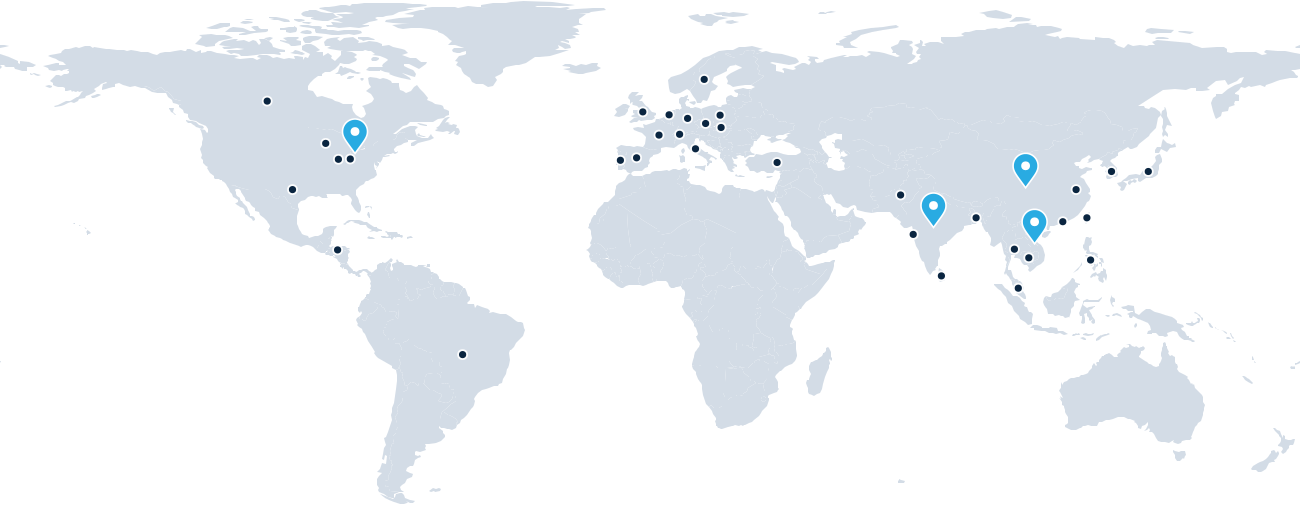
Our own teams sit in the markets where products are made. We source direct from factories across 30 countries — and inspect, consolidate and import through our own offices rather than an agent’s.
We look at consumer brands across the home — and we’re straightforward about whether we’re the right owner for yours.
